How cilock-k8s works, end to end
This document walks through every stage of the PoC — what each script in
dev/ creates, why it exists, and what happens at admission time.
The big picture
Supply-chain security question this PoC answers: "only run container images that we can prove were built by our pipeline."
The proof is a signed attestation (evidence recorded at build time), and the rule is a signed policy (what evidence is required). The admission webhook is the enforcement point that connects the two.
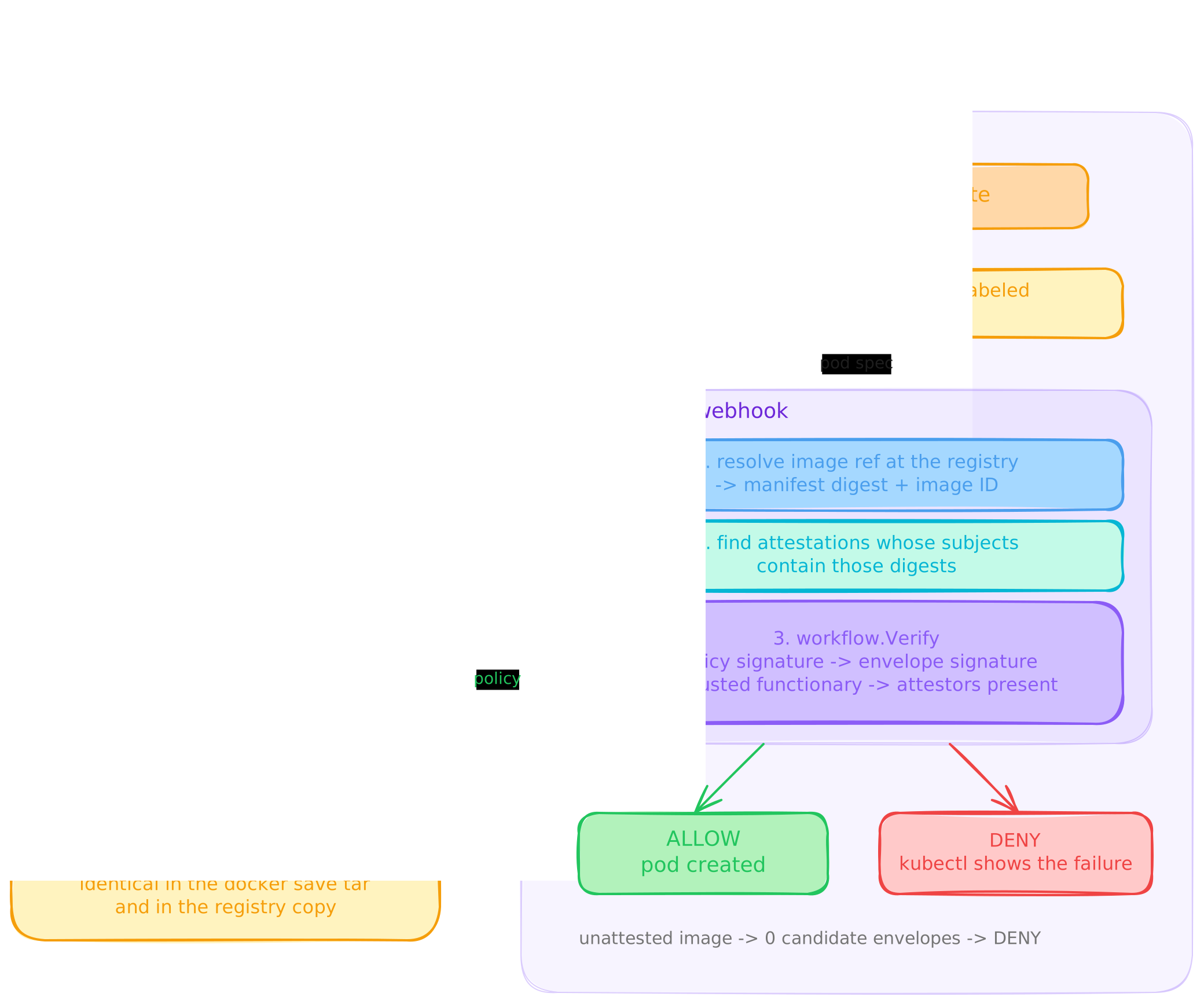
Three artifacts cross from build time to admission time:
| artifact | what it is | mounted at |
|---|---|---|
build.att.json |
signed DSSE collection envelope — the evidence | /etc/cilock/attestations/ |
policy.signed.json |
signed witness policy — the rule | /etc/cilock/config/ |
policy-pub.pem |
public key the webhook trusts to have signed the policy | /etc/cilock/config/ |
Stage 1 — dev/kind-up.sh: a cluster with a real registry
Creates two things:
- A registry container (
cilock-registry,registry:2image) published onlocalhost:5001on your host. - A kind cluster (
cilock) whose containerd is configured with a mirror so that image refs likelocalhost:5001/fooare fetched from the registry container over the docker network.
Why a registry at all? The webhook verifies the image a pod references,
which means it must resolve localhost:5001/cilock-demo:1 to content digests
by asking a registry. kind load docker-image (which copies an image
straight onto the node) would leave nothing for the webhook to query. A real
push/pull through a registry is also what production looks like.
Why the containerd mirror? localhost:5001 only means something on your
host. Inside a kind node, "localhost" is the node itself — so nodes are told
"when asked for localhost:5001, fetch from http://cilock-registry:5000
instead" (that's the hosts.toml the script writes into each node).
Stage 2 — dev/gen-certs.sh: TLS for the webhook
The Kubernetes API server only calls admission webhooks over HTTPS, and it must be told which CA to trust. The script creates:
ca.crt/ca.key— a throwaway CA.ca.crtgets base64-embedded as thecaBundlein the ValidatingWebhookConfiguration ("API server, trust certificates signed by this").tls.crt/tls.key— the serving certificate, with subject alternative namecilock-webhook.cilock-system.svc— exactly the DNS name the API server uses to reach the webhook Service. Wrong SAN = TLS handshake failure = (withfailurePolicy: Fail) every pod creation in enforced namespaces rejected.
These certs are about transport security between the API server and the webhook — completely separate from the attestation-signing keys in stage 3.
Stage 3 — dev/attest-demo.sh: evidence and policy
This is the "build pipeline" of the demo. Step by step:
- Builds
cilockfrom your local rookery checkout (CILOCK_DIR) intodev/.bin/cilock. - Generates a signing keypair (
dev/.keys/policy-key.pem/policy-pub.pem). For simplicity one key plays both roles: the functionary (signs attestations) and the policy signer (signs the policy). In production these would be different identities — e.g. keyless Fulcio certificates per CI run for attestations, and an offline org key for the policy. - Builds and pushes the demo image
localhost:5001/cilock-demo:1. - Attests the build:
cilock run --step build -a oci --signer-file-key-path … \
  -- docker save -o demo.tar localhost:5001/cilock-demo:1
cilock run executes the wrapped command and records attestations around
it, then signs everything into one DSSE collection envelope
(build.att.json). The attestors that run:
material— inputs present before the command,product— files the command produced (demo.tar),oci— parses the produced tar and records the image's image ID (config digest), manifest digest, layer digests, and tag as subjects of the attestation.
The subjects are the whole trick: they are the digests this evidence is about, and they're what the webhook searches by later.
Why attest a
docker savetar instead of the pushed image? The tar's manifest digest differs from the registry's, but the image ID (config digest) is identical in both. That makes the image ID the reliable join key between "what the build machine attested" and "what the node will run". (This detail is what the original 2022 PoC struggled with.)
- Pushes an unattested control image (
localhost:5001/unattested:1, plain busybox) so you can demo the deny path. - Generates the policy:
cilock policy from-bundlesinspects the attestation bundle and emits a starter policy that says roughly "a step namedbuildmust exist, containing material/product/oci attestations, signed by a functionary with this public key". Thencilock signwraps the policy itself in a signed DSSE envelope (policy.signed.json) — the policy is trusted content too; an unsigned policy could be swapped out.
Stage 4 — dev/deploy.sh: the enforcement point
- Builds the webhook binary on your host (
CGO_ENABLED=0 GOOS=linux) and acilock-k8s:devimage from it, thenkind loads it onto the node. (Host-built becausego.modreaches into the local rookery checkout viareplacedirectives that a Docker build context can't see.) - Looks up the registry's IP on the docker network and passes
--registry-alias localhost:5001=<ip>:5000to the webhook. Same problem the containerd mirror solves for nodes, solved for the webhook pod: it receives image refs sayinglocalhost:5001but must dial the registry container instead.--insecure-registrymarks it as plain-HTTP (dev registry has no TLS). - Creates the runtime objects:
- Secret
cilock-webhook-tls— the serving cert/key from stage 2, - ConfigMap
cilock-config—policy.signed.json+policy-pub.pem, - ConfigMap
cilock-attestations— the attestation envelope(s), - Deployment + Service
cilock-webhookin namespacecilock-system. - Registers the
ValidatingWebhookConfiguration— this is what makes the API server call us. The important fields:
| field | value | meaning |
|---|---|---|
rules |
CREATE pods |
only pod creation is intercepted |
namespaceSelector |
cilock-policy: enforce |
only namespaces with this label are enforced — this is also what keeps the webhook from blocking kube-system or itself |
failurePolicy |
Fail |
if the webhook is down, pod creation in enforced namespaces is rejected (fail-closed) |
clientConfig |
service + caBundle |
where to call, and which CA to trust |
Stage 5 — admission time
When you kubectl run a pod in an enforced namespace:
- The API server sends the webhook an
AdmissionReviewcontaining the full pod spec (the pod does not exist yet — nothing has been scheduled or pulled). - The webhook walks every
initContainerandcontainerimage ref, resolves each against the registry (applying aliases), and gets the manifest digest + image ID. workflow.Verifyruns the full witness verification: policy signature → candidate attestation search by subject digest → envelope signature → functionary/key check → required-attestor check per policy step.- Allow or deny. On deny, the error you see from
kubectlis the verification failure, and the pod is never created.
Reading the webhook logs
From a real run:
[verified-source] verifying 1 candidate envelope(s) for collection "build"
[dsse-verify] roots=0 intermediates=0 verifiers=1 timestampVerifiers=0 sigs=1
[verified-source] envelope … signature OK (verifier kid=c5c613cf4b59)
PASS pod=cilock-demo/attested … imageid=sha256:b76c… steps=[build]
1 candidate envelope(s)— the subject-digest search found an attestation whose subjects contain this image's digest. Signature is then verified (signature OK, with the key ID).- For the unattested image you instead see
verifying 0 candidate envelope(s) for collection "build"— no evidence even mentions this image's digests, so the policy'sbuildstep can't be satisfied →DENY. That "0 candidates" line is the search coming up empty, which is exactly the point.
What's deliberately simplified (PoC)
- Evidence is static ConfigMap mounts. Real deployments would query
Archivista (any
source.Sourcercan be plugged in). - One key signs everything; no keyless/Fulcio, no timestamps, no cert chains.
- Only
CREATE podis checked — enough, since every higher-level workload eventually creates pods.